



Unlocking the Power of Multiplex IHC with Cyclic Labelling
Discover how cyclic labelling enables cost-effective, high-content spatial protein mapping using standard reagents and clever experimental design.
Helen Murray
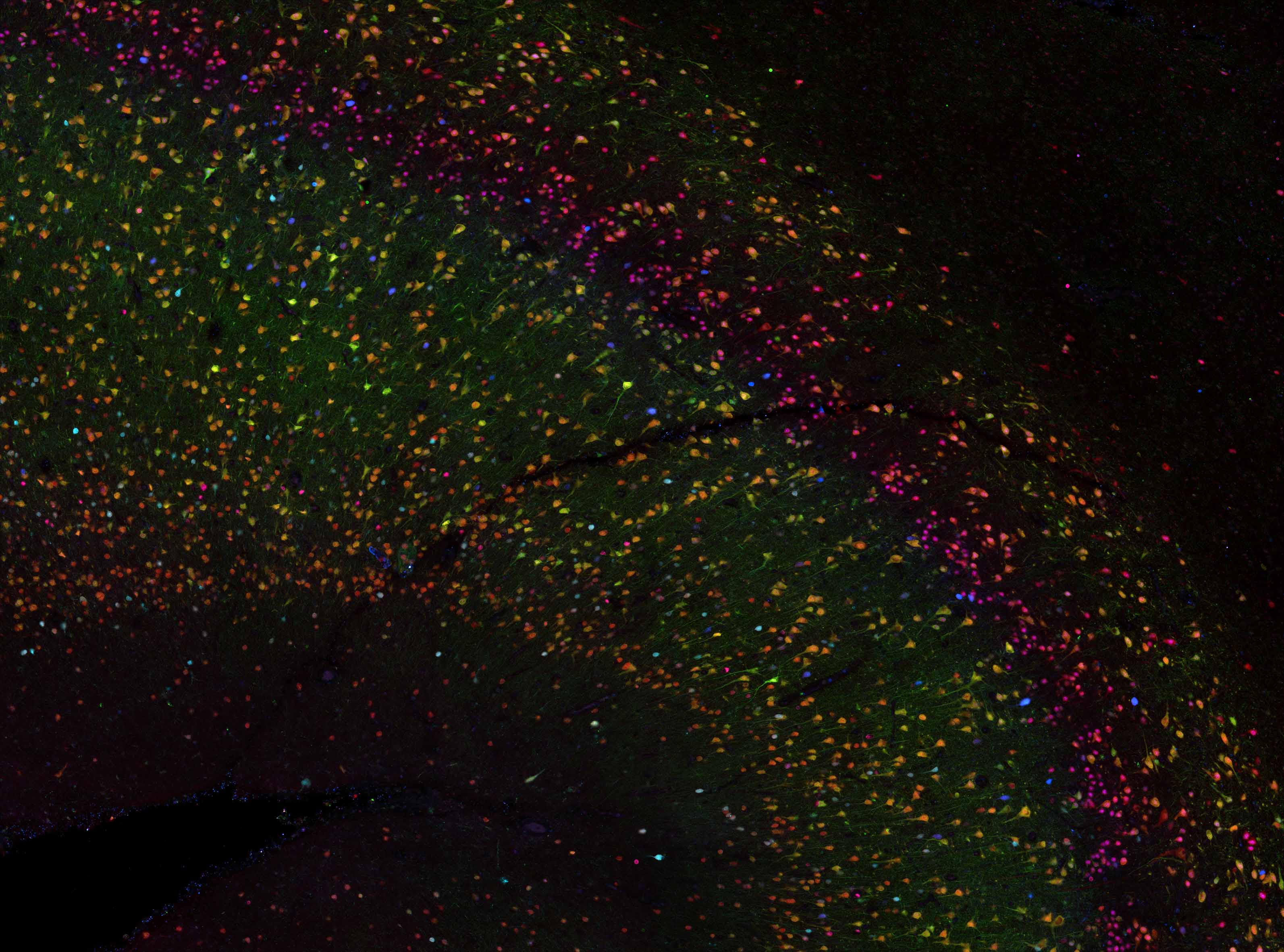
The explosion of omics techniques in the last decade has transformed how we think about biological complexity. Discover how cyclic labelling enables cost-effective, high-content spatial protein mapping that rivals commercial platforms.
Why Multiplexing Matters
Spatial transcriptomics and proteomics techniques are allowing us to capture the complexity of cytoarchitecture and unlocking new insights into cellular processes and disease mechanisms. Multiplex immunohistochemistry (IHC) is one such tool that offers the ability to create spatial maps of large numbers of proteins.
Multiplexing increases the power and efficiency of anatomical studies by maximising the amount of spatial protein data acquired from a single tissue section.
Commercial multiplexing platforms are powerful, but they're also costly and often rely on proprietary reagents or dedicated imaging systems. An accessible alternative lies in approaches built on standard reagents combined with clever experimental design.
With the right planning, you can generate high content datasets at a fraction of the cost, leveraging antibodies you already know and trust.
From Two to Ten: Scaling Antibody Panels
Traditionally, immunofluorescence panels might contain just two markers. But with minimal adjustment, expanding to five or more antibodies is possible.
The major limitation here isn't necessarily the antibodies themselves, but the microscope. You'll need access to a microscope that can spectrally separate the different fluorophore emissions.
For example, most widefield fluorescence microscopes can image:
- DAPI
- Alexa Fluor 488
- Alexa Fluor 546 or 594
But with most systems, additional filters for Alexa Fluor 647 and 750 can be added if the light source is compatible.
Pro Tip: Check what fluorophores your microscope can spectrally separate before designing your panel. This simple step can save you hours of troubleshooting.
Another strategy to increase labelling plex is to expand your repertoire of primaries by using mouse monoclonal antibodies with different IgG subtypes.
Because many secondary antibodies are isotype-specific (e.g., anti-mouse IgG1 vs IgG2a), you can label multiple mouse monoclonal primary antibodies simultaneously and pair each with a unique fluorophore.
Key benefits of this approach:
- Adds flexibility to your panel design
- Maintains the extra signal amplification that a secondary antibody provides
- Helps maximize the information from even a single round of staining
Cyclic Labelling: Going Beyond the Limits
Even the most advanced custom microscopes can only handle so many fluorophores at once. That's where cyclic labelling comes in.
Instead of trying to detect all target proteins in a single round, you label, image, and then strip antibodies, repeating the process for multiple rounds. With each successive round, you can build a dataset containing dozens of markers on the same tissue section.
Common antibody stripping methods include:
- Citrate buffer + high temperature – A gentler option but may leave some residual signal
- Commercial stripping reagents – Cost a little more and can be more harsh on the tissue, but very effective
A successful cyclic labelling experiment also requires gentle coverslip removal. Try immersing your slides vertically in warm PBS and let the coverslips fall off by themselves. The less force you apply, the better the tissue will fare across multiple rounds.
Validated Workflows: Our group and others have validated these antibody stripping cyclic-labelling workflows. Check out our publications showing reproducible multi-round staining with minimal loss of tissue integrity: Murray et al. (2022) and Osterman et al. (2025).
Data Alignment and Analysis
One of the biggest technical challenges of cyclic labelling is image alignment across rounds. Even slight damage during coverslip removal can cause problems when merging datasets.
Fortunately, there are free and open-source tools that help with affine image transformation. Our team uses Warpy – a QuPath and ImageJ plugin that enables elastic registration of large histology images.
What Warpy enables:
- Accurate alignment of sequential staining rounds
- Creation of single multiplex datasets from multiple rounds
- Handling of large histology images efficiently
Tools like Warpy allow you to accurately align sequential rounds of staining, creating a single comprehensive multiplex dataset ready for analysis.
Managing Antibodies and Experiments with AbTrove
Planning a multiplex experiment requires meticulous management of reagents. Keeping track of which antibodies were used, at what dilutions, with which secondary, and in which cycle can quickly become overwhelming.
That's where AbTrove comes in. AbTrove helps researchers manage their antibody libraries, track metadata, and generate experiment sheets that you can tailor for multiplexing workflows.
Key features for multiplex IHC:
- Track antibody dilutions and conditions across multiple rounds
- Generate custom experiment sheets for cyclic labelling protocols
- Share optimised antibody panels with lab members
- Improve experimental reproducibility
- Avoid costly reagent mix-ups
By centralizing this information, you can streamline the experimental planning process—saving both time and money.
Ready to Streamline Your Multiplex Workflow?
Join researchers who are saving hours on antibody management
Try AbTrove Free →Conclusion
Multiplex IHC using cyclic labelling is a powerful, accessible, and cost-effective alternative to high-end commercial platforms. By combining careful antibody design, thoughtful fluorophore selection, and reliable stripping/alignment workflows, it's possible to scale single panels into large, spatially rich datasets. With tools like AbTrove supporting antibody management, the technical and organizational barriers to multiplex IHC are lower than ever—opening the door to deeper insights into tissue biology.